
The 50% Profit Target on Short Options: The Math
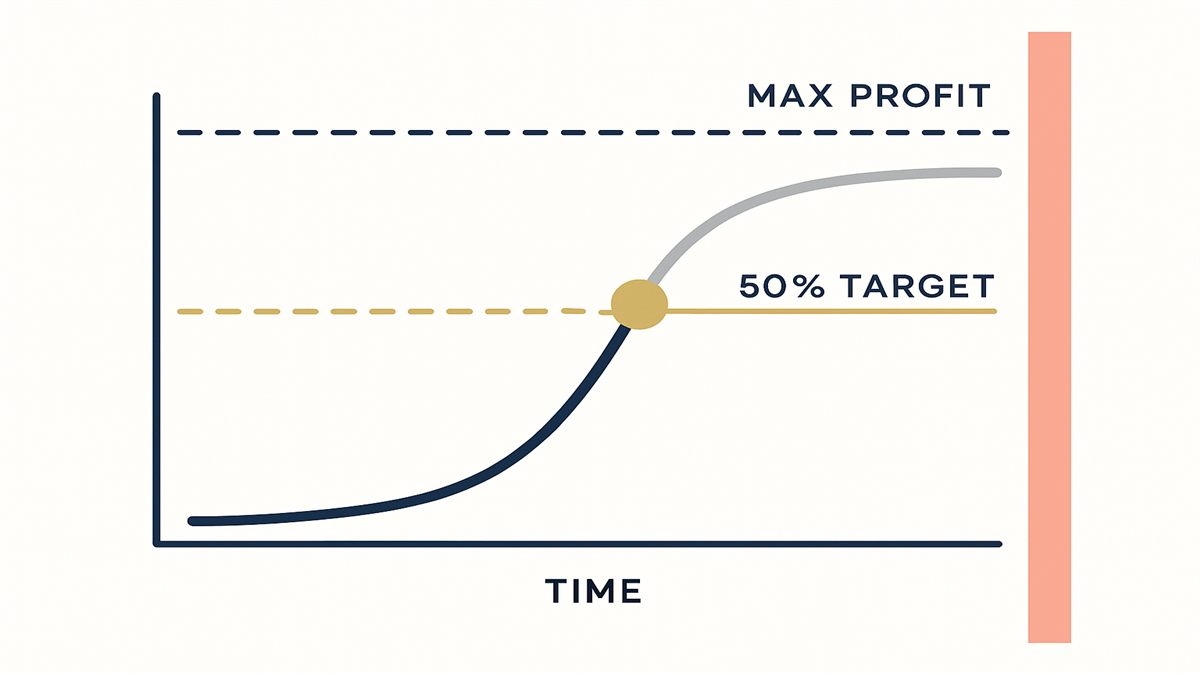
Taking a 50% profit target on short options is one of the most repeated rules in premium selling, and one of the most argued about. Every trader who has closed an iron condor at half its credit and then watched it expire worthless has asked the same question: why leave the other half on the table? This post walks through the math behind the rule, using a real-sized trade, so you can see exactly what you give up and what you get back.
What the 50% Profit Target Means
When you sell a credit spread or an iron condor, the credit you collect is the most the trade can ever make. A 50% profit target means you buy the position back once it costs half of that credit to close.
Sell an iron condor for $2.50, and the target is a $1.25 buyback. You keep $125 per contract and the trade is over. It doesn’t matter whether that happens in nine days or thirty.
The 50% is measured against the credit received. A $2.50 credit on a 10-wide condor risks $750, and the target captures $125 of a possible $250.
Why Holding to Expiration Is a Worse Trade Than It Looks
The trade you are holding is not the trade you opened
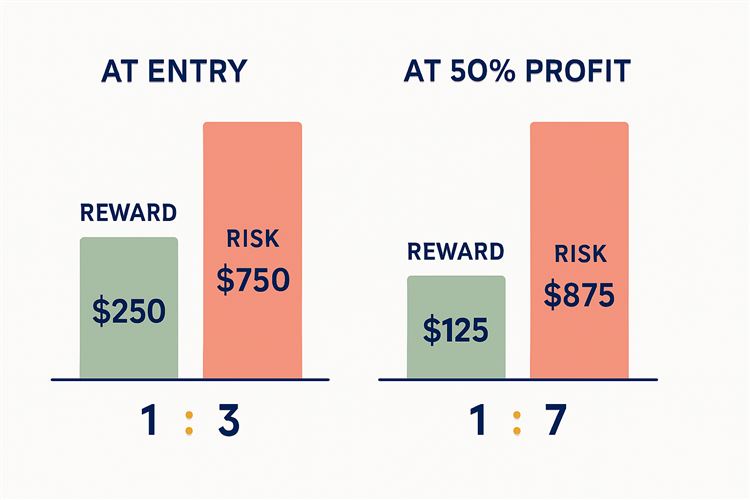
Once a condor reaches 50%, the position you hold has different numbers from the one you opened, and it deserves to be judged as if you were opening it today.
Take the 10-wide condor sold for $2.50:
| At entry | At 50% profit | |
|---|---|---|
| Position value (cost to close) | $2.50 | $1.25 |
| Remaining profit if it expires worthless | $250 | $125 |
| Remaining loss if it goes to max loss | $750 | $875 |
| Reward to risk on what is left | about 1 : 3 | about 1 : 7 |
At entry you risked $3 to make $1. After the target hits, staying in means risking $875 to chase the last $125. I wouldn’t open a fresh trade at that ratio, and holding past the target amounts to doing just that.
Gamma grows while the reward shrinks
The second half of the credit also arrives on worse terms. Theta speeds up near expiration, which sounds like good news, but gamma speeds up faster. In the last few weeks a modest move in the underlying can swing a short strike’s delta hard, and the condor’s value can double in a day.
So the remaining $125 comes slowly and late, right when the position is most sensitive to a move. That is the same reason systematic traders close by 21 days to expiration even when the profit target hasn’t hit. How iron condors generate income covers the decay curve in more detail.
How the 50% Profit Target Changes the Numbers Over Many Trades
A single trade can go either way. The rule pays off across a few hundred of them, and it does so in three ways.
Win rate goes up
A position that has reached half its credit has not yet had the chance to become a loser. Closing it locks in the win. Holding gives the market more time, and more gamma, to turn a winner into a scratch or a loss.
tastytrade’s published research on managing winners found that closing at 50% raised the win rate compared with holding to expiration. The rule trades a smaller average win for many more of them, and in short premium the frequency of wins matters as much as their size.
Capital turns over faster
The first 50% of a condor’s credit usually comes in faster than the second 50%. That’s partly from theta, and partly because a drop in implied volatility after entry knocks value out of both short strikes at once.
Here is an illustrative case. A 45 DTE condor that reaches 50% in 15 days frees its buying power with 30 days still on the clock. That capital can open a new position in a fresh, higher-IV setup instead of sitting in a trade that has very little left to give. Over a year, the same account runs more independent trades, and more independent trades make results less dependent on any one of them.
Profit per day improves
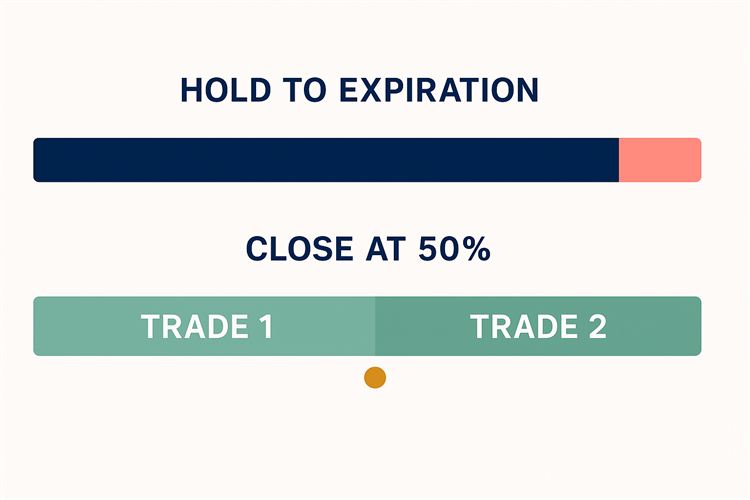
The fair way to compare management styles is profit per day of capital at risk, not profit per trade. Holding to expiration maximizes dollars per trade. Closing at 50% usually wins on dollars per day, because the dollars it skips are the slowest and riskiest ones in the trade.
The Other Half of the Rule: Losses Still Need a Plan
A profit target alone doesn’t make a strategy. At 50%, the average winner is $125 on a trade that risks $750, so the edge depends on keeping the average loser well short of max loss.
That is why the profit target works as a pair with an exit for losers and a time stop. A position that is tested gets defended or closed before it reaches the far end of the range, and anything still open at 21 DTE gets closed regardless of P/L. The profit target sets how much you keep, and the loss rules set how much you give back. How ACondor defends options trades under pressure covers the loss side.
How ACondor Applies the 50% Profit Target
ACondor checks every open position on a short cycle throughout the trading day. When an iron condor or credit spread can be bought back for half of the credit it collected, the bot sends the closing order on its own, priced from the live market for that exact spread. If the position is still open at 21 days to expiration, the time stop closes it whether or not the target was reached.
Rules like this are easy to state and hard to follow by hand. The target often hits on a quiet Tuesday afternoon when you’re not watching, or on a morning when IV collapses before you’ve opened the platform. A system that checks on every cycle takes the 50% when it’s there, instead of when you happen to look.
ACondor also keeps watching after it exits. For several days after each close it records what the position would have been worth if it had been held, so every exit rule, the profit target included, gets graded on real outcomes. How ACondor keeps its edge honest explains why that measurement matters more than any single rule.
Common Misconceptions About the 50% Profit Target
“You’re leaving half the money on the table.” You are leaving the half with the worst reward to risk in the whole trade. The money on the table is the last $125 attached to $875 of exposure.
“50% is a magic number.” It’s a tradeoff point. A lower target such as 25% closes faster and wins more often but keeps less per trade. A higher one keeps more per win but holds through more gamma. 50% has held up well across published studies, which is why it’s the standard. ACondor runs 50% on live accounts and tests a 25% target on a paper account as a controlled comparison, rather than assuming either is right.
“If it’s at 50% in two days, I should hold for more.” A fast 50% usually means implied volatility dropped. That’s the best case for the rule. You got most of the expected edge in a fraction of the time, and the capital is free for the next setup.
Frequently Asked Questions
Is the 50% profit target measured on credit or on max loss?
On the credit received. A condor sold for $2.50 closes at a $1.25 buyback, capturing $125 per contract no matter how wide the spread is.
Should I use a 50% profit target on every short option trade?
It’s a sound default for defined-risk credit structures like iron condors and credit spreads held 30 to 60 days. Very short-dated trades and debit spreads follow different math and usually use different targets.
What if the trade never reaches 50%?
Then the time stop handles it. Most systematic traders close any position still open at 21 days to expiration, which keeps a stalled trade from sitting in the high-gamma final weeks.
Does closing early cost more in commissions?
It adds one closing order per trade. On a $125 target that cost is small, and it usually buys you out of a position whose remaining risk is several times its remaining reward.
Ready to Automate Your Options Trading?
ACondor handles iron condors, earnings plays, and volatility strategies automatically in your tastytrade account. It closes winners at the profit target and manages losers by rule, with no manual entries and no missed setups.
Request Early Access and be first when we open to new accounts.
Ready to Automate Your Options Trading?
ACondor handles iron condors, earnings plays, and volatility strategies automatically in your tastytrade account. No manual entries, no missed setups.
Request Early Access →