
How ACondor Trades Earnings With Iron Condors
Earnings season is where a lot of systematic traders either make their year or blow up their risk limits. Selling premium into an earnings report is one of the most documented edges in options trading, but it’s also the fastest way to lose a defined-risk trade’s worth of profit overnight if the structure or timing is wrong. This post walks through exactly how ACondor’s earnings engine trades iron condors around a report, and where it differs from a standard mechanical iron condor.
What Is the ACondor Earnings Engine?
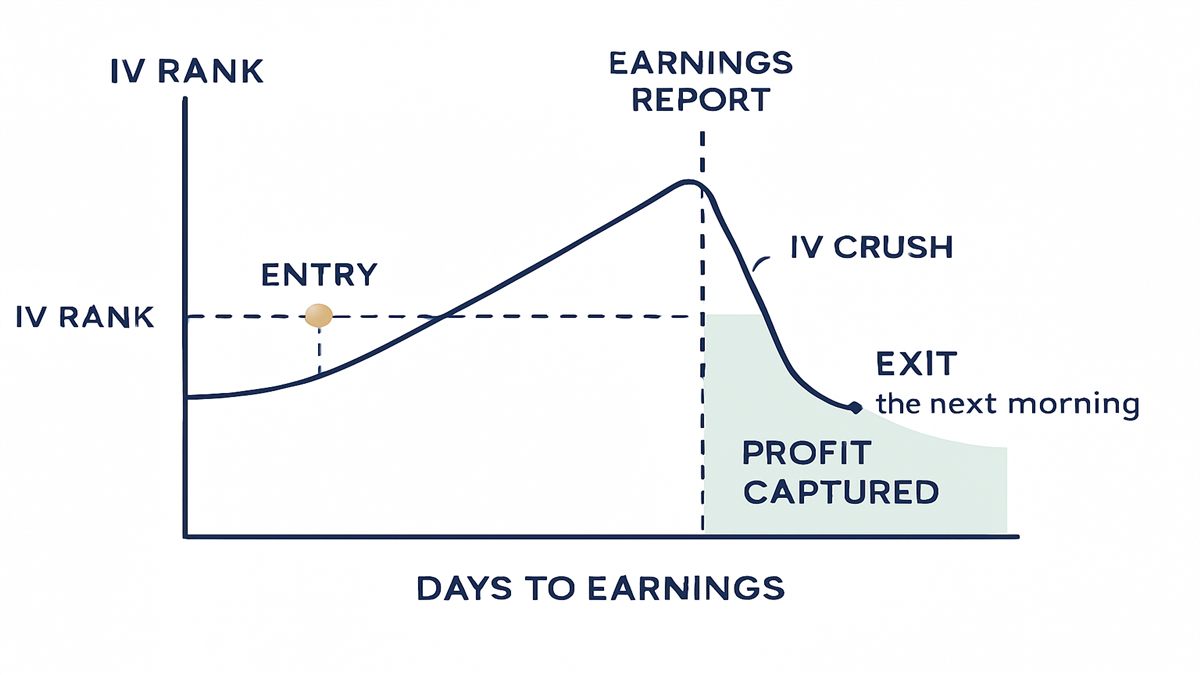
The earnings engine is one of ACondor’s four trading engines, built specifically to sell premium into the IV ramp that builds before a scheduled earnings release. Implied volatility inflates in the days before a report because the market is pricing in the possibility of a large move. Realized volatility, the move that actually happens once the number is out, tends to be smaller than what was priced in.
That gap between implied and realized volatility is the thesis. The earnings engine sells a defined-risk structure, most often an iron condor or a single-sided credit spread, before the report, holds through the release, and closes the position once the volatility crush plays out. It is a short, event-driven trade, not a 30 to 45 day mechanical position.
Why Trading Earnings With Iron Condors Is Different
A standard mechanical iron condor, entered 30-65 days out and held for theta decay, profits from steady time decay over weeks. An earnings trade compresses all of that into a single overnight event. You are not collecting theta day by day, you are collecting a volatility premium that either gets released cleanly in your favor or gets blown through by a gap.
That difference changes almost every parameter of the trade: how close to the report you enter, how far out you strike the wings, how much size you put on, and how quickly you exit. Robin’s earnings engine treats each of those as a separate, deliberately tuned dial rather than reusing the mechanical engine’s settings.
How the Earnings Engine Works
Entry: IV Rank and Proximity to the Report
The engine requires IV Rank at or above 50 on the underlying before it will even look at an earnings trade. Below that threshold, the premium being offered doesn’t justify the binary risk of holding through the report.
Timing follows that IV Rank threshold, not a fixed calendar countdown. Some names inflate a full week before they report, others don’t get expensive until the final day or two. The engine also checks a separate proximity gate, the report has to fall within a configurable window (three days by default) of the current date. Both the IV Rank floor and the proximity gate have to clear before the engine opens anything.
Selection: Calm Names First
Not every name that reports is a candidate. The engine screens out stocks with a beta above 1.3, and skips any name whose implied move is priced above 8% of the stock price. A stock the market expects to move 11% overnight is a genuine binary event, and no strike placement makes selling premium into that attractive. The names that survive both screens are then ranked calmest-first, smallest implied move as a percentage of price at the top, so the quietest setups get the available slots.
The engine also builds its own scoreboard for this: every earnings candidate it evaluates, whether it trades the name or not, records the implied move before the report and the realized move after it. Over time that becomes a per-name history of which stocks actually stay inside their expected move, the exact screen professional premium sellers use and no data vendor sells.
Strikes: Anchored Beyond the Implied Move
This is the engine’s defining rule. The options market publishes its own forecast of the earnings move in the price of the at-the-money straddle, and the engine reads it directly. Each short strike has to sit at the further of two anchors: the 16-delta strike (roughly one standard deviation out) and 1.3 times the implied move from the stock price. A name pricing a big print gets its shorts pushed proportionally further out, automatically. If the chain has no strike far enough away, the engine passes on the trade rather than sit inside the move.
The structure is defined-risk: an iron condor or a single credit spread with 10-point wings, the same width the mechanical engine uses. And the trade only goes on when the credit is at least a third of the wing width, the classic condor rule. With strikes anchored beyond the implied move, plenty of names won’t pay that much. Skipping them is the point: the engine only sells an earnings print when the market is paying a fair price for the risk. Undefined-risk, naked short strikes are available but off by default, and only run on individual symbols you’ve added to the earnings naked-symbols allowlist, and only on a margin account, never in an IRA or cash account.
Expiry: At Least a Week Past the Report
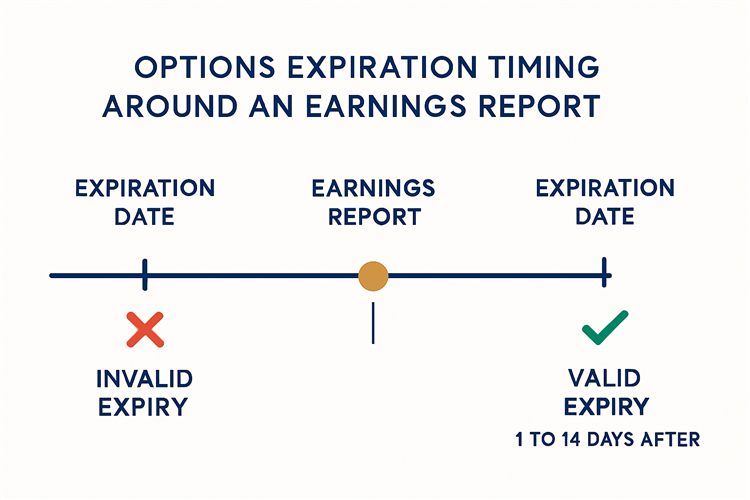
The expiry the engine chooses has to fall strictly after the earnings date, and at least seven days after it. That buffer is deliberate: it leaves real time on the clock after the print, which is what makes the exit logic below possible. If no expiry fits, the engine skips the name rather than force a trade into a bad expiration.
A Worked Example
A large-cap name reports earnings after the close on a Wednesday. On Monday, its IV Rank crosses 52, above the 50 floor, and the report falls inside the default three-day proximity window. The stock trades at $120 with a beta of 1.1, and the at-the-money straddle prices a $6 implied move, 5% of the stock price. Both selection screens pass, and the name ranks near the top of the earnings list because its implied move is among the smallest on the slate.
The strike anchor requires each short at least 1.3 × $6 = $7.80 from the stock price, and the 16-delta strikes sit a touch further out, so those win: the engine sells an iron condor with a put short around $111 and a call short around $129, with $10-wide wings on each side. The condor has to collect at least $3.33, a third of the wing, or the trade is skipped. The maximum loss is capped at the wing width minus the credit, known before the trade is ever placed. Thursday morning, after the report and the volatility crush that follows it, a position at the 50% profit target closes immediately; otherwise it’s managed under the standard defense rules on the week-plus of time remaining.
Position Sizing and the Earnings Allocation Cap
Position size on earnings trades is intentionally the smallest across all four engines. Each earnings trade is a single overnight bet on one company’s report. What controls the risk isn’t making any one trade bigger, it’s how many of these binary positions are open across the book at once, which is capped separately from the other engines. The full list of earnings engine parameters, including the exact IV Rank floor, DTE band, and delta defaults, is in the engine documentation.
Exit: Bank the Crush, Then Defend Like Any Other Position
Most earnings positions resolve the same way: the report comes out, IV collapses, and the position closes at the 50% profit target the next session. The crush is banked and the trade is done.
A position that isn’t at target hands off to the same management rules that govern every other ACondor position. That’s what the week-past-the-report expiry buys: a tested short strike gets delta defense and the roll ladder, winners-in-progress keep working toward the profit target, and assignment protection has the last word when a short goes deep in the money. The earnings trade gets a real defense instead of a single make-or-break morning, while the defined-risk wings keep the worst case capped the entire time.
Common Misconceptions About Earnings Trades
“Selling earnings premium is just gambling.” The edge isn’t in predicting the direction of the move, it’s in the persistent gap between what IV prices in and what actually happens. Over a large sample of trades, defined-risk structures sold at elevated IV Rank have a real, measurable edge. Any single trade can still lose.
“A wider spread is always safer.” Wider wings give the structure room to be slightly wrong, but width alone isn’t safety, the credit has to justify the risk. That’s why the earnings engine pairs its 10-point wings with a hard credit floor: at least a third of the wing width, or no trade. Width without a fair credit is just a bigger max loss.
“You should hold through multiple earnings cycles for a bigger win.” The entire structural advantage of an earnings trade is that it’s short and defined. Holding a position through a second binary event to chase more premium gives back the risk control the structure was built for.
Frequently Asked Questions
Does the earnings engine ever use naked strikes?
Rarely, and only when you’ve added that specific symbol to the earnings naked-symbols allowlist, and only on a margin account. The engine’s default across every setup is a defined-risk structure, an iron condor or credit spread with a capped maximum loss.
How is earnings position sizing different from mechanical?
Earnings trades run at the smallest size of ACondor’s four engines, since each one is a single overnight bet on a binary event. The risk control comes from limiting how many earnings positions can be open across the account at once, not from sizing any individual trade larger.
What happens if there isn’t a clean expiry after the earnings date?
The engine skips the trade. An expiry that falls before the report, or too far outside the configured post-earnings window, doesn’t meet the entry conditions, so no position gets opened on that name for that cycle.
Can earnings positions get rolled like mechanical positions?
Yes, once the report has passed. An earnings position uses an expiry at least a week beyond the report, and the morning after the announcement it hands off to the same management rules as a mechanical position: a tested short strike gets delta defense and the roll ladder, and assignment protection has the last word. Before the report, the position simply holds through the event, since holding through the crush is the trade.
Can the earnings engine be turned off during heavy reporting weeks?
Yes. The earnings engine has its own on/off toggle, separate from the mechanical and contraction engines, so it can be disabled entirely during a week with many overlapping reports while the rest of the book keeps trading. There’s also a dedicated allocation cap and an optional hard cap on the number of simultaneous earnings positions, so the exposure can be bounded without switching the engine off completely.
Ready to Automate Your Options Trading?
ACondor handles iron condors, earnings plays, and volatility strategies automatically in your tastytrade account. No manual entries, no missed setups.
Request Early Access and be first when we open to new accounts.
Ready to Automate Your Options Trading?
ACondor handles iron condors, earnings plays, and volatility strategies automatically in your tastytrade account. No manual entries, no missed setups.
Request Early Access →