
Iron Condor Buying Power on tastytrade: How Much You Need
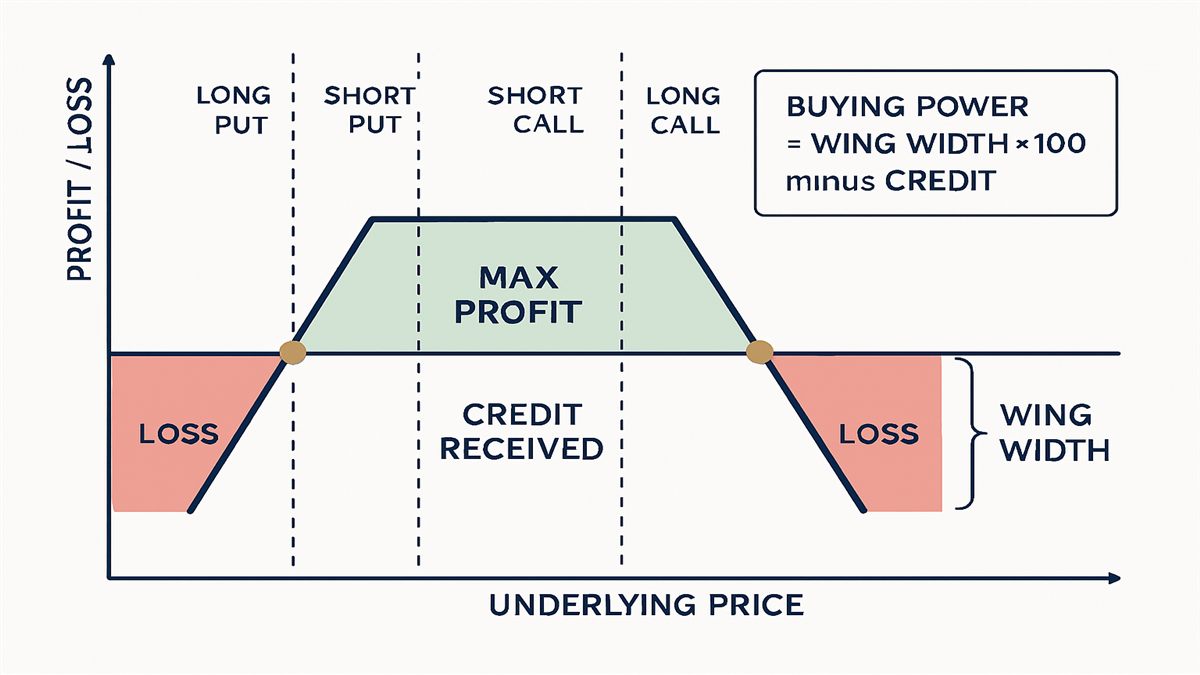
Iron condor buying power on tastytrade is easy to calculate for one trade and easy to get wrong for a strategy. The broker shows you the buying power reduction before you send the order. What it does not show you is how many of those trades your account can carry at once, how much room you need left over when the market moves, and the point where one loss becomes too large a share of the account. This post works through all three with the numbers ACondor actually uses, so you can see what account size a systematic premium-selling strategy needs before you commit capital to one.
It assumes you already sell premium. If “short strike,” “wing,” and “net liq” need defining, start with how iron condors generate income first.
What Is Iron Condor Buying Power?
Buying power reduction (BPR) is the capital tastytrade sets aside while a position is open. For an undefined-risk trade like a short strangle, it comes from a margin formula that moves with price and volatility. For an iron condor it is simpler, because the long wings define the worst case.
On a defined-risk iron condor, BPR is the width of the wider spread times 100, minus the credit you collected. Only one side of a condor can finish in the money at expiration, so tastytrade holds the risk of one side, not both.
Take a 10-wide condor on an index ETF that collects $2.00. The wing is $1,000 of risk per contract. Subtract the $200 credit and the buying power reduction is $800. That $800 is also your max loss. On a defined-risk trade, buying power and max loss are the same number, which makes the sizing math cleaner than on almost anything else you can sell.
Why One Trade’s Buying Power Is the Wrong Number to Plan Around
Most traders size the first condor correctly and then get the account wrong. They see $800 of BPR on a $25,000 account, decide that is about 3%, and stop thinking. The problem is that a systematic strategy never holds one condor.
A premium-selling edge shows up across many occurrences. The tastytrade research that most of us learned from is built on hundreds of trades, not a handful. With only two positions open, the result depends on how those two trades go, and the edge never has room to show up. What you need to size is the whole book: enough positions to spread across underlyings and expirations, each small enough that a full loss is survivable.
There is a second reason. Buying power in use is not the same as buying power you can afford to use. If a manual position you hold in the same account gets tested, or you want to roll something, you need free buying power to do it. A fully deployed account has no room to manage anything.
How Much Capital a Systematic Strategy Needs
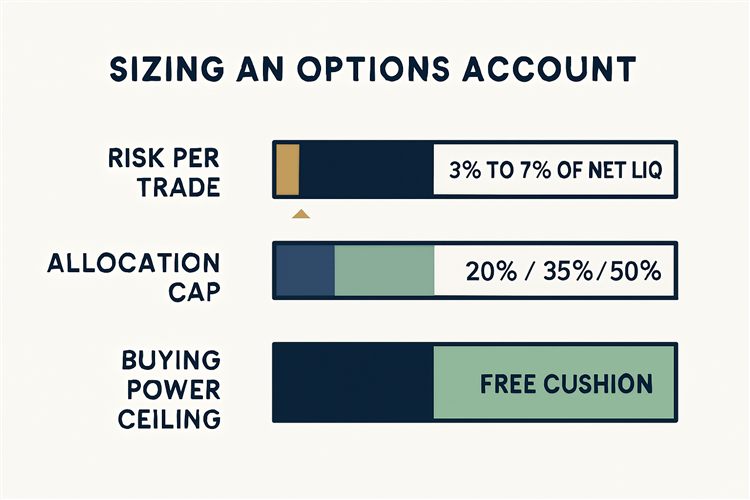
Three limits decide how many condors an account can carry, and each one binds at a different account size. ACondor enforces all three before every entry, and checks the buying power effect with tastytrade’s own margin dry-run rather than an estimate.
Limit 1: Risk Per Trade
The per-trade cap sets the largest loss any single position may carry. A sensible range for premium selling is roughly 2% to 8% of net liquidating value, depending on how aggressive you are.
This is the limit that sets your account floor. A standard 10-wide index condor risks somewhere between $700 and $900, depending on the credit. In live trading, a QQQ condor that risked $874.50 and an SPY condor that risked $711 were both ordinary entries. If your per-trade cap is 5% of the account, a $900 condor needs an $18,000 account. At 3%, it needs $30,000.
Below that size the account can still trade, but it cannot take the standard trade. It has to take narrower wings or cheaper underlyings, and narrow wings are a known problem. tastylive’s wing-width study of roughly 5,000 trades found $5 wings lost money in every price bucket it tested. ACondor widened its default from 5-wide to 10-wide for that reason.
There is also a ceiling running the other way. On a large account, 5% of net liq could allow a single trade risking several thousand dollars. ACondor caps any single trade at $1,000 regardless of account size. On a larger account the system takes more of the same small trade, and each one stays the same size.
Limit 2: Allocation
The allocation cap limits how much buying power the strategy may deploy across all open positions at once. ACondor’s risk profiles set it at 20% (Conservative), 35% (Balanced) and 50% (Active) of net liq.
This is what turns a per-trade number into a position count. On a $30,000 account:
| Profile | Deployed at most | Condors at ~$900 BPR |
|---|---|---|
| Conservative (20%) | $6,000 | about 6 |
| Balanced (35%) | $10,500 | about 11 |
| Active (50%) | $15,000 | about 16 |
Six to sixteen positions across several underlyings and expirations gives the strategy enough occurrences to work with. Almost any options account can afford one condor. The account size question is whether it can afford enough of them to diversify.
Limit 3: The Account-Wide Buying Power Ceiling
The allocation cap counts what the strategy deploys. The buying power ceiling counts everything in the account, including positions you opened by hand. Before each entry ACondor checks that the trade would still leave a required share of net liq free, measured against tastytrade’s own remaining buying power figure.
This matters most if you share an account between the bot and your own trading. A manual short put that is eating $8,000 of buying power leaves less room for the system, whether or not the system has hit its own allocation cap. The free cushion is also what lets you, or the bot, roll a tested position instead of being forced to close it at the worst moment.
The Practical Floor: Putting the Three Limits Together
Put the three limits side by side and the account sizes fall into three ranges.
- Under about $11,000: a standard 10-wide index condor risks more than 8% of the account, which is past the most aggressive profile. You can trade, but the structures that fit are the weaker ones, and you cannot hold enough positions to diversify.
- About $18,000 to $30,000: the standard condor fits the per-trade cap at 3% to 5%, and the allocation cap allows a handful to a dozen positions. This is the working range for a systematic approach.
- $35,000 and up: at a 2% per-trade cap, the $700 default trade fits, and at 35% allocation the book has room for about 17 positions. This is where the strategy has room to behave the way the research describes.
These ranges are guidelines, and ACondor enforces no minimum. It will run on a smaller account and will tell you on screen which trades the cap is refusing and why, but it will not quietly shrink a trade to make it fit.
Account Type Changes the Picture
Account type changes which structures you can trade as well as how much buying power they use.
In a margin account, a defined-risk condor uses exactly its max loss in buying power, and undefined-risk structures are possible if you choose them. In an IRA or cash account, only defined-risk trades are allowed, and the capital requirement for a condor is effectively the same max loss. ACondor reads the account type from tastytrade and restricts itself to defined-risk structures in IRA and cash accounts automatically. You do not configure that, and you cannot override it by mistake. The full list is on the requirements page.
Common Misconceptions About Iron Condor Buying Power
”A condor ties up buying power on both sides”
It does not. tastytrade holds the risk of the wider side only, because price can only finish past one side at expiration. A 10-wide condor uses less buying power than a single 10-wide credit spread, because the second side adds credit without adding risk.
”More credit means more buying power”
The reverse is true. Credit is subtracted from the wing width, so a richer condor of the same width uses less buying power. That is one reason elevated implied volatility is the time to sell: you get paid more for the same capital at risk.
”If I have the buying power, I can afford the trade”
Buying power tells you whether the broker will accept the order. It does not tell you whether the position fits your book. An account can have the buying power to put 60% of net liq into condors on three correlated tech names. Whether it should is a sizing question, and that is what the allocation and sector limits are for. ACondor caps positions per market sector for this reason, so a quiet week does not fill the book with five semiconductor condors.
”I’ll just raise my allocation once I trust it”
Raising it over time is sensible. Base the increase on how the system behaved through a full market cycle, since one good month says little. ACondor’s risk profile only re-derives its dollar limits when account value moves 20% from where they were last set, so a strong week does not raise your risk without you seeing it. How that works across more than one account is covered in how ACondor manages risk across multiple accounts.
Frequently Asked Questions
How much buying power does an iron condor use on tastytrade?
Wing width times 100, minus the credit received, per contract. A 10-wide condor that collects $2.00 uses $800 of buying power, which is also its maximum loss.
What is the minimum account size to trade iron condors systematically?
There is no hard minimum, but a standard 10-wide index condor risks $700 to $900. At a 5% per-trade cap that needs about $18,000 of net liq, and at 3% about $30,000. Smaller accounts must use narrower wings or fewer positions, both of which weaken the strategy.
Can I trade iron condors in an IRA on tastytrade?
Yes. Iron condors are defined risk, so they are allowed in IRA and cash accounts. The capital set aside is effectively the max loss, the same as in a margin account.
How much buying power should I keep free?
Enough to roll or close a tested position without forcing a sale. Premium sellers commonly keep half or more of net liq free. ACondor enforces this as an account-wide floor that counts your manual positions too.
Ready to Automate Your Options Trading?
ACondor handles iron condors, earnings plays, and volatility strategies automatically in your tastytrade account. It checks every trade’s buying power with tastytrade’s margin dry-run before it places the order and enforces your per-trade, allocation and buying power limits on every entry. No manual entries, no missed setups.
Request Early Access and be first when we open to new accounts.
Ready to Automate Your Options Trading?
ACondor handles iron condors, earnings plays, and volatility strategies automatically in your tastytrade account. No manual entries, no missed setups.
Request Early Access →