
How ACondor's Contraction Engine Trades a Volatility Spike
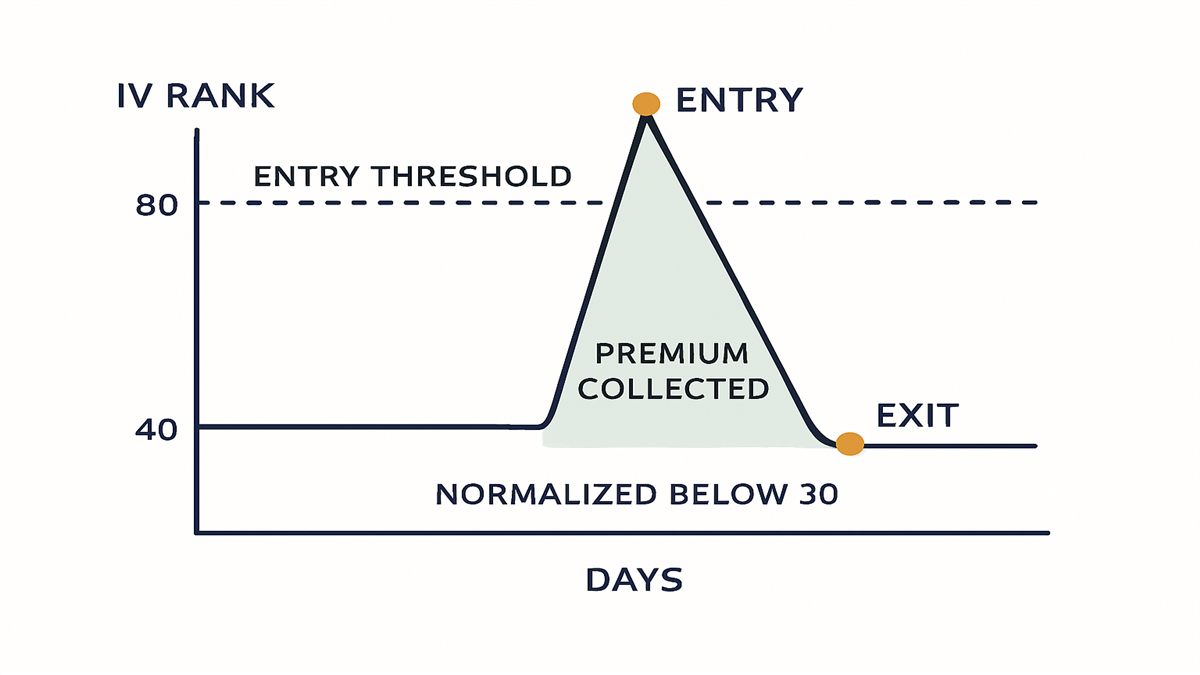
Most premium-selling systems are built for one thing: steady, elevated IV Rank that decays slowly over weeks. But some of the richest premium in the market shows up for a completely different reason, a sudden, sharp spike in implied volatility that has nothing to do with a scheduled event. This post walks through how ACondor’s contraction engine finds that spike, why it trades it differently from every other engine in the book, and where it stops.
What Is the ACondor Contraction Engine?
The contraction engine is one of ACondor’s four trading engines, and it exists for a narrow, specific situation: implied volatility has jumped hard and fast, and history says it is statistically likely to mean-revert. That could be a sector rotation, a single-name news shock, or a broad market spike day with no scheduled catalyst behind it at all.
The thesis is simple. Elevated IV Rank tends to fall back toward its historical range faster than most traders expect, often losing a large share of an extreme reading within a week or two. The contraction engine sells a short-dated, defined-risk position into that spike and harvests the decay as volatility normalizes, rather than waiting weeks for a mechanical position to play out.
Why a Volatility Spike Is Different From Elevated IV
A standard mechanical iron condor enters when IV Rank clears its floor and holds for 30 to 65 days of theta decay. That works because the elevated IV Rank it enters on is usually a stable, sustained condition, not a one-day event. The contraction engine is built for the opposite case: a name that jumped from an unremarkable IV Rank to an extreme one in a matter of days.
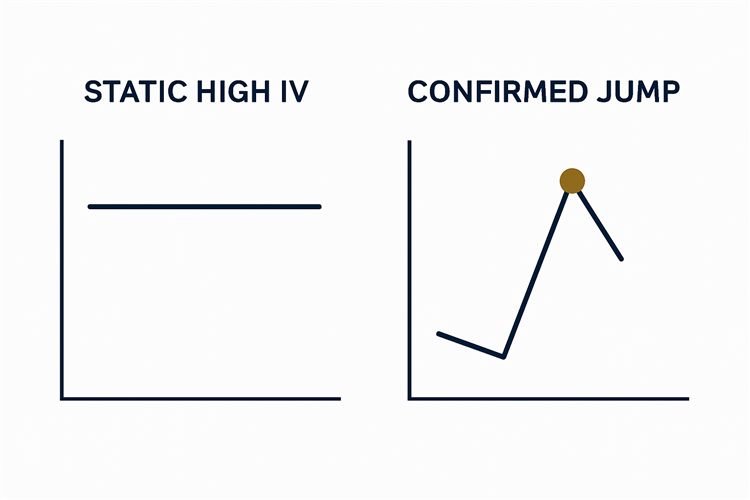
That distinction matters because a static high-IV name and a genuinely spiking one look identical if you only check the current reading. A stock parked at IV Rank 85 for three straight weeks has structurally elevated volatility, maybe from an ongoing corporate situation, and doesn’t behave the way a fresh spike does. Trading it like a contraction setup would mean holding a short-dated position against volatility that has no particular reason to fall soon.
How the Contraction Engine Works
Entry: A Genuine Spike, Not a High Plateau
The engine requires two conditions before it will look at a name, not one. First, IV Rank has to be at or above 80, a genuine extreme. Second, that reading has to represent a confirmed jump, by default a rise of at least 20 IV Rank points within the recent lookback window. The jump requirement is what separates a fresh spike from a stock that has simply sat at a high IV Rank for weeks.
The engine also checks that the name isn’t inside its own scheduled earnings window. Earnings-driven IV spikes have a known catalyst and a known date, and ACondor routes those to a dedicated earnings engine built around that structure. The contraction engine is reserved for spikes with no known event date behind them, the ones that lean entirely on the news gate and statistical mean reversion rather than a calendar.
Structure: Short-Dated, Defined-Risk, Higher Probability
The default structure is an iron condor, with credit spreads and directional fallbacks available when the setup calls for a single-sided trade. Every structure the engine will run is defined-risk. Naked strikes are never allowed on this engine, full stop, regardless of account type.
Short strikes target 16 delta, roughly one standard deviation, noticeably tighter than the 20-delta shorts the mechanical engine uses. That extra probability cushion exists because contraction trades run on a much shorter clock, a 7 to 21 day window rather than 30 to 65 days, and there’s less time for a tested strike to recover before expiration forces the issue.
A Worked Example
A mid-cap industrial name trades at an unremarkable IV Rank of 40 for weeks. A supply chain headline hits on a Tuesday morning with no earnings report anywhere near the date, and by Wednesday the stock’s IV Rank has jumped to 84, a 44-point move that clears both the 80 floor and the 20-point jump requirement.
The engine checks the earnings calendar, confirms nothing is scheduled in the relevant window, and evaluates strikes at 15 days out, inside the 7 to 21 day band. It sells a defined-risk iron condor with 16-delta short strikes and $5-wide wings on each side, collecting a credit up front with the maximum loss capped and known before the trade goes on. Over the following week, as the headline fades from the news cycle and realized volatility comes in below what was priced, IV Rank on the name drops back toward 30.
Exit: Whichever Comes First
Three conditions can close the position, and the engine takes whichever fires first. A 50% profit target is the primary exit and tends to fire quickly once the crush plays out. Separately, the engine will close on IV normalization, once IV Rank falls back below 30, but only if every short strike is still untested, meaning delta hasn’t crept up past roughly 0.45 on either side. A tested short doesn’t get the harvest-style exit at all, it falls through to the same roll ladder the rest of the book uses, because a tested position needs delta defense, not a label that says volatility calmed down.
The third exit is a hard backstop: close at 3 days to expiration regardless of profit and loss. That’s tighter than the mechanical engine’s 21-day rule, and deliberately so, since contraction positions already enter inside a 7 to 21 day window. Waiting until 21 days to expiration on a trade that entered at 15 would mean holding straight through to expiry with no chance to manage it.
Common Misconceptions About Trading Volatility Spikes
“High IV Rank always means a good entry.” IV Rank discipline is only half the picture. A stock that has quietly sat at IV Rank 85 for a month is not the same trade as one that just jumped there overnight, and the contraction engine’s jump requirement exists specifically to keep the two apart.
“Tighter deltas mean it’s a safer trade than mechanical.” The 16-delta shorts give a wider probability cushion per trade, but the position is also short-dated and reactive to a live news event, not a scheduled one. The cushion offsets the added uncertainty, it doesn’t eliminate it.
“You should hold past the profit target for more premium.” The entire edge in a contraction trade is capturing the fast part of the reversion. Once IV Rank has normalized and the profit target has hit, there’s no structural reason left to be in the position, and every extra day is exposure to a fresh, unrelated move in the name.
Frequently Asked Questions
How does the contraction engine avoid overlapping with the earnings engine?
It explicitly excludes any name with scheduled earnings inside its entry window. A volatility spike tied to a known earnings date routes to the earnings engine’s structure and timing instead, since that engine is built around a known event date rather than an open-ended news catalyst.
Why 16-delta shorts instead of the 20-delta shorts the mechanical engine uses?
Contraction trades run on a much shorter clock, 7 to 21 days instead of 30 to 65. The tighter delta gives a higher probability of expiring untested inside that compressed window, which matters more when there’s less time for a tested strike to recover.
What happens if a contraction position gets tested before volatility normalizes?
It doesn’t get the IV-normalization exit at all. A tested short, meaning delta has crossed roughly 0.45, falls through to the standard roll ladder instead, the same defensive process used across the rest of ACondor’s engines.
Does the contraction engine trade often?
No. It’s built to sit dormant for long stretches and then activate when a genuine spike appears, whether that’s a sector rotation, a single-name news shock, or a broad market event. It is not a steady, always-on income engine the way the mechanical engine is.
Can the contraction engine be turned off?
Yes. It has its own on/off toggle, separate from the mechanical and earnings engines, so it can be disabled if the short-dated management cadence isn’t a fit for how you want to run the account, while the rest of the book keeps trading normally.
Ready to Automate Your Options Trading?
ACondor handles iron condors, earnings plays, and volatility strategies automatically in your tastytrade account. No manual entries, no missed setups.
Request Early Access and be first when we open to new accounts.
Ready to Automate Your Options Trading?
ACondor handles iron condors, earnings plays, and volatility strategies automatically in your tastytrade account. No manual entries, no missed setups.
Request Early Access →