
Iron Condor Expiration: Picking the Window and the Exit
Choosing an iron condor expiration comes down to two decisions: which expiration you sell, and how close to it you are willing to hold. Most traders spend their attention on strikes and credit and pick the date last, even though the date decides how much time decay you collect and how exposed you are in the final days. This post covers how ACondor picks the window for each kind of trade, and why the decision to close the day before expiry has no single right answer.
What the expiration window controls
Every iron condor is a bet that the underlying stays between two short strikes until you close the trade. The expiration you pick changes the terms of that bet.
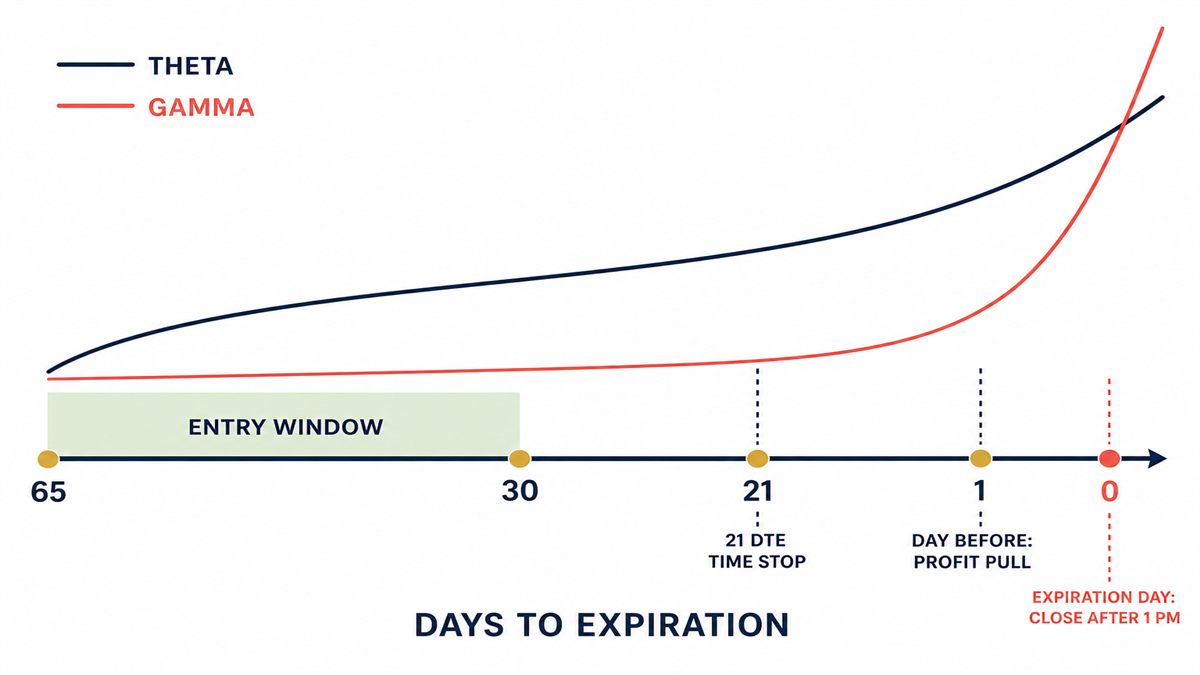
Start with time decay. Theta on an out-of-the-money condor is slow far from expiry and speeds up as the date approaches. Selling 45 days out collects a real share of that decay without sitting in the final weeks.
Gamma moves the other way. The closer you get to expiration, the more a one-point move in the stock changes the delta of your short strikes. A move that barely registers at 40 DTE can put a short strike in the money at 4 DTE.
Liquidity matters too. Standard monthly expirations (the third Friday) carry deeper open interest and tighter bid-ask spreads than most weeklies. On a four-leg order, a few cents of spread per leg adds up, both on the way in and on the way out.
How ACondor picks an iron condor expiration
ACondor runs several engines, and each one sizes the window to the reason it is trading. A single fixed DTE rule would fit one of them and fight the others.
The mechanical engine: 30 to 65 days
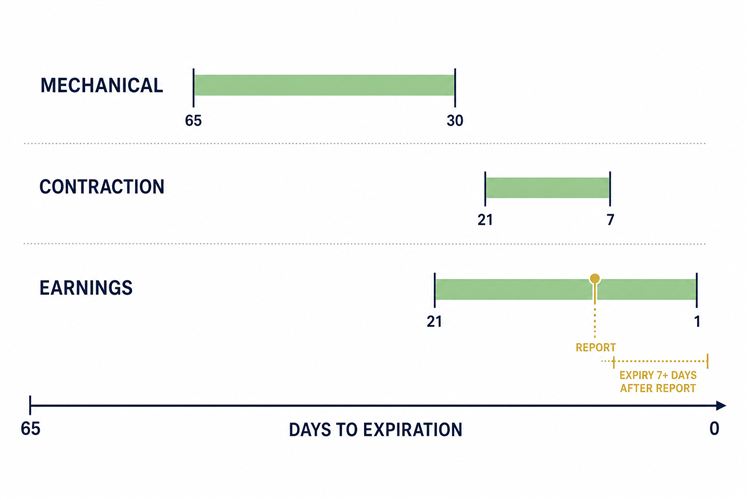
The mechanical engine sells premium on names with elevated IV rank and no earnings inside the window. It enters between 30 and 65 days to expiration and prefers the monthly cycle when one falls inside that range.
The upper bound used to be lower. With a 45-day ceiling, a monthly expiration only sat inside the window for about 7 to 10 days each month, so the engine either waited or settled for a thinner weekly. Extending the ceiling to 65 keeps a monthly in range for roughly three weeks of every month. The 30-day floor keeps entries out of the stretch where gamma starts to dominate.
Once a mechanical position is open, the first exit to fire wins: 50% of max profit, a stop at 2x the credit received, a defense when a short strike reaches 0.45 delta, or a time stop at 21 DTE, so a mechanical trade is normally closed three weeks before it expires. The 50% profit target post walks through why the 50% and 21 DTE exits pair well.
The contraction engine: 7 to 21 days
When IV rank spikes on news rather than a scheduled event, implied volatility tends to fall back quickly. The contraction engine sells a short-dated, defined-risk position to collect that drop, entering between 7 and 21 days out.
A 21 DTE time stop makes no sense for a trade that may be opened at 15 DTE, so this engine uses 3 DTE instead. It also exits when IV rank falls back to 30, since at that point the volatility it was selling is gone. How the contraction engine trades a volatility spike covers the full cycle.
The earnings engine: anchored to the report
Earnings trades start from the report date, and the DTE comes second. The engine enters within 3 days of the report and requires the expiration to fall at least 7 days after it, with 21 DTE as a ceiling.
The 7-day buffer replaced the nearest weekly. With that weekly, a condor that got tested by the print had one or two sessions left and no room to defend. A week of runway after the report gives the management rules time to work. Once the report passes, the position is managed under the mechanical rule set. How ACondor trades earnings with iron condors explains the IV crush side.
The last two days: two rules, one hard and one soft
Time stops keep most positions away from expiration. Some still get there, for example when a closing order does not fill or an account owner has moved the defaults. For those, ACondor has two rules that apply to every engine.
Expiration day: close everything after 1 PM Eastern
On the expiration day itself, ACondor closes the whole position after 1:00 PM ET, whether it is a winner or a loser. This rule has no profit threshold.
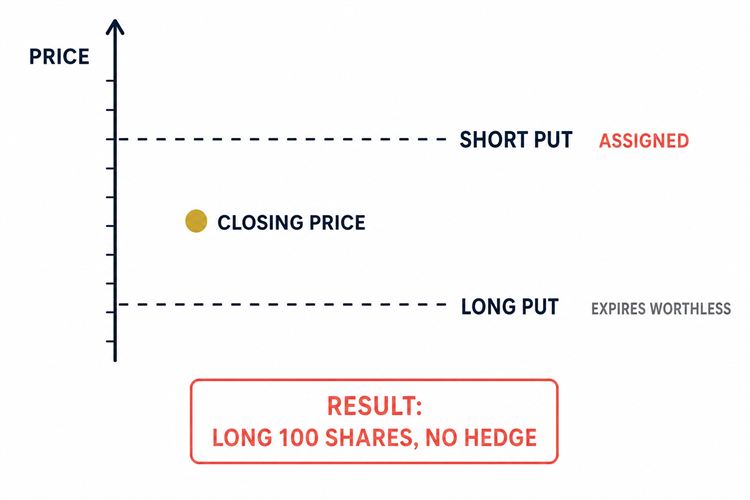
The reason is pin risk. Suppose the stock closes between your short put and your long put. The short put is in the money and gets assigned. The long put expires worthless. You go into the weekend long 100 shares per contract, with none of the protection the long wing was supposed to provide. Holders can also exercise based on after-hours news, so a short strike that looked safe at the close can still be assigned.
Waiting until 1 PM lets the position collect the morning’s decay, which is the largest daily theta in the trade. Closing costs on tastytrade are small next to the risk of an unhedged stock position, so the bot buys the condor back instead of betting on a clean expiration.
The day before: close if the trade has made at least 25%
With one day left, ACondor closes a profitable position early if it has captured at least 25% of its maximum profit. Below that floor it holds, and the expiration-day flatten takes it out the next afternoon.
The rule exists because of a real position: profitable, expiring the next day, and nothing in the rule set told the bot to close it.
Why the day-before close is a judgment call
The expiration-day flatten is about avoiding an outcome you cannot price. The day-before pull is a different kind of decision. It trades a small, likely gain against a small chance of a large loss, and reasonable traders set the line in different places.
Take a 10-wide iron condor sold for $2.00. Max profit is $200 per contract and max loss is $800.
| Value the day before expiry | Profit so far | Share of max profit | Default rule |
|---|---|---|---|
| $0.30 | $170 | 85% | Close |
| $1.40 | $60 | 30% | Close |
| $1.70 | $30 | 15% | Hold to the flatten |
The first row is easy. Holding risks up to $970 more to collect the last $30, and almost no one would open that trade fresh.
The third row is where people disagree. A condor still worth $1.70 one day before expiry usually has the stock sitting near a short strike. Closing it banks $30 after spread and fees, and some traders would take that and move on. Others point out that one more session of decay is worth more here than on any other day, and that the other exit rules keep running while the position is held. The 25% floor keeps the bot from paying the spread to close for pennies, and it also means a barely-green position takes one more session of risk.
That tradeoff depends on the account. A trader who has taken a loss the last day before expiry tends to want a lower floor, and one who watches small winners get closed for almost nothing wants a higher one. ACondor exposes it as a per-account setting, expiry_close_profit_min_pct, with a documented range of 10% to 75%. The expiry profit pull setting page has the details.
Common misconceptions about iron condor expiration
“Holding to expiration maximizes profit.” It maximizes profit per trade on the trades that work. It also keeps you in the highest-gamma days and exposes you to pin risk on the ones that end near a strike. Profit per day of capital at risk usually favors closing earlier.
“An expiring out-of-the-money condor is free money.” The options are worth little at the close, but the stock can still move after hours, and exercise decisions are made on that move. Out of the money at 4 PM does not guarantee no assignment.
“Weeklies are just like monthlies with less time.” For a liquid ETF they can be close. For many single stocks, weekly chains have thinner open interest and wider spreads, and that cost shows up on all four legs twice.
Frequently asked questions
What is the best DTE for an iron condor?
For a standard premium-selling condor, 30 to 60 days is the common range, and ACondor’s mechanical engine uses 30 to 65 so a monthly expiration is usually available. Shorter windows make sense only when the trade has a short thesis, such as a volatility spike or an earnings report.
Should I let an iron condor expire worthless?
Letting it expire saves one closing order and adds pin and assignment risk on the final day. ACondor closes every position on expiration day after 1 PM Eastern instead of taking that chance.
Why close at 21 DTE if the profit target hasn’t hit?
After 21 DTE, gamma grows faster than the remaining premium. A stalled trade at that point has little left to give and a lot more sensitivity to a move, so closing it frees the capital for a fresh position.
Can I change the day-before-expiry close threshold?
Yes. In ACondor it is the expiry_close_profit_min_pct setting, 25% by default, adjustable per account between 10% and 75%.
Ready to automate your options trading?
ACondor handles iron condors, earnings plays, and volatility strategies automatically in your tastytrade account. It picks the expiration window for each engine and runs the end-of-cycle exits on every position, with no manual entries and no missed setups.
Request Early Access and be first when we open to new accounts.
Ready to Automate Your Options Trading?
ACondor handles iron condors, earnings plays, and volatility strategies automatically in your tastytrade account. No manual entries, no missed setups.
Request Early Access →